Lewis-Clark Press October 2007
Out of Print
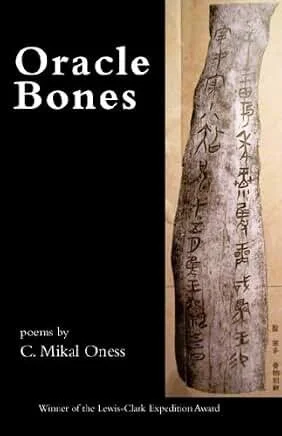
Oracle Bones was selected as the winner of the Expedition Prize, sponsored by Lewis-Clark Press.
Author Mark Doty writes, "Elegy, exorcism, expiation, charms against dread: poetry's old work is disarmingly vital here. C. Mikal Oness's poems are steeped in Old English poetics, but bent to a distinctly modern tune. 'Oracle Bones' is ghosted by fish and by birds, by human presence and oncoming darkness, but suffused too by a tenderness that does not deny how deeply haunted these poems are, holding out the possibility of hope despite, and the actuality of praise." Peter Everwine notes, "In 'Oracle Bones' two voices alternate and sometimes overlap. One voice is descriptive and narrative; the other, speaking in intimate poems of four or five lines, is lyrical, runic, mysterious. The effect is one of text and supra-text, not a random collection of poems but a deepening exploration of themes that center on loss, love, and our attendant responsibilities. Allusions to fly fishing-casting a line to draw up, by artifice, what lies beneath a surface, under dark rocks or weeds-often appear as metaphors in these poems. Oness casts such a line, and what he brings to light is both surprising and beautiful." Oness's newest collection of poetry is sensitive and significant, a pleasure to read and necessary for all readers of contemporary poetry.
No Reply Press 2025
View or Purchase on No Reply Press website (ignore price and inventory listings here on TheLastPress.com).
EIGHTY-EIGHT TANKA BY C. MIKAL ONESS⠀•⠀DRAWINGS BY GARY YOUNG
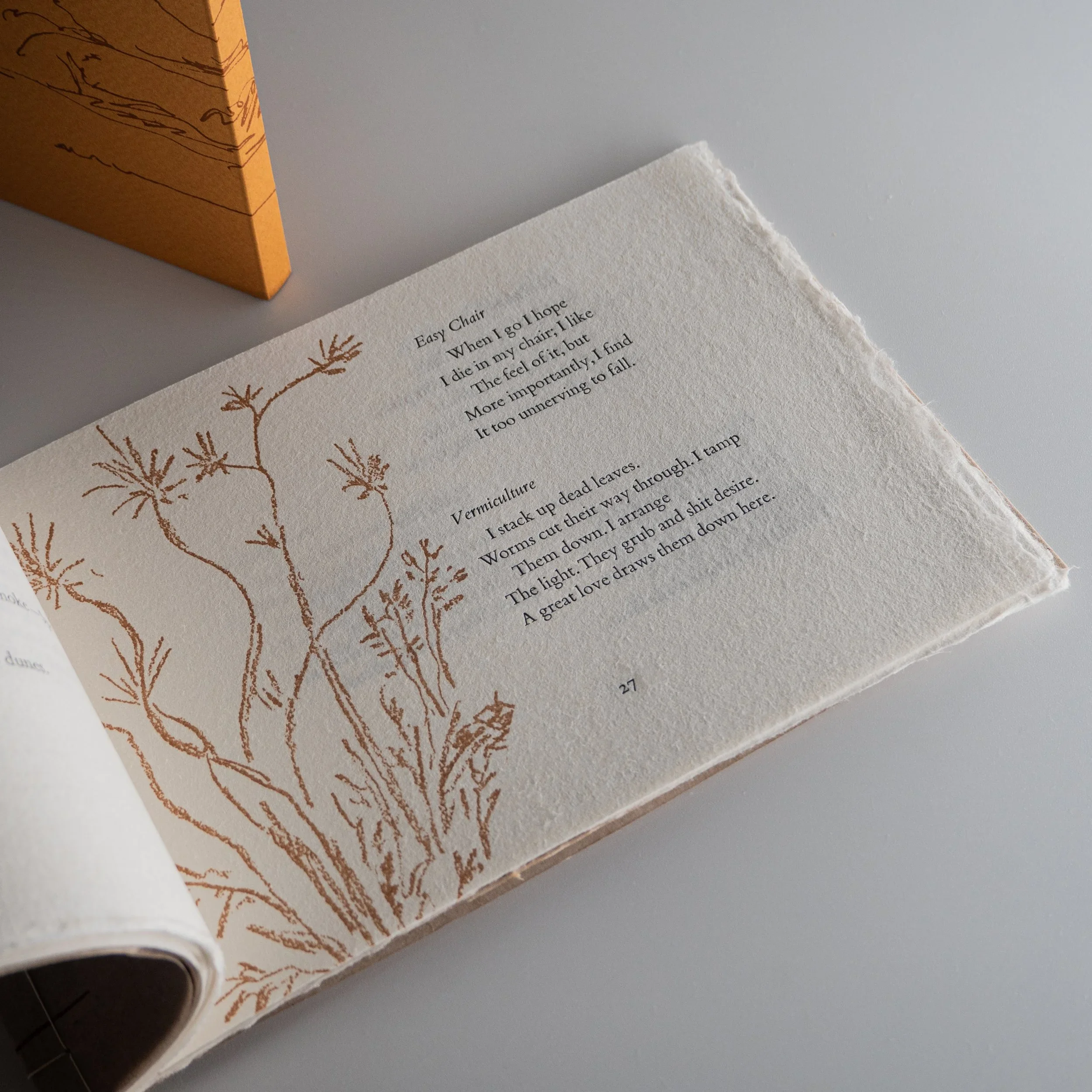
Chad Oness, one of the great private pressmen of the past half century, astounds with this new collection of eighty-eight tanka.
Great literature should be a portal. Read, and find yourself in another place, another milieu, with other concerns and aspirations. This collection transports us to the hermitage, Chad’s home, in a time of flux and timelessness, a time of new ambitions and aging, with chores to do and great art to make. What a joy it is to have read this “private literature” and to share it now with just a small circle. This is the rare collection with the capacity to imbue the “ho hum” of life with poignancy, hilarity, frustration – in short – with meaning.
The tanka, or “short poem,” is a Japanese form which follows a simple 5-7-5-7-7 syllable scheme. It is tricky and inviting in equal measure, often coming to a point which demands that the reader return to the beginning. Like flash fiction, it is defined as much by the space around the work as by the work itself. This constellation of eighty-eight tanka pulls off a marvelous feat in giving the reader such a full understanding of a time and place in so few words.
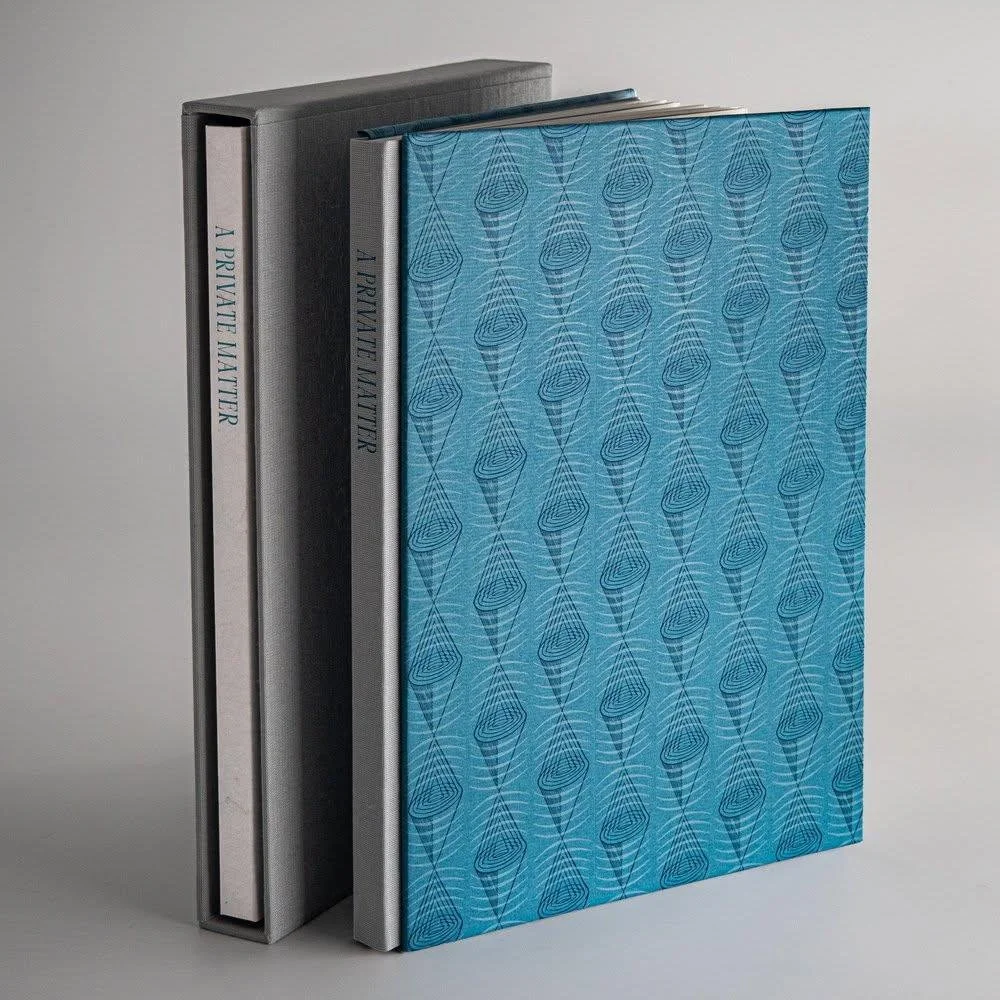
The poems are manually printed on handmade Japanese papers, in the very setting they describe, and have been bound in the most famous of Japanese styles. Our twist to this timeless form is a stiff chemise (with a hidden compartment!) perfect for shelving and protecting its precious cargo from the elements. Chad, after all, keeps his own fine press collection on his sailboat…
Essays
No Reply Press 2026
View and purchase only on No Reply Press website — (Ignore inventory listings here on TheLastPress.com).
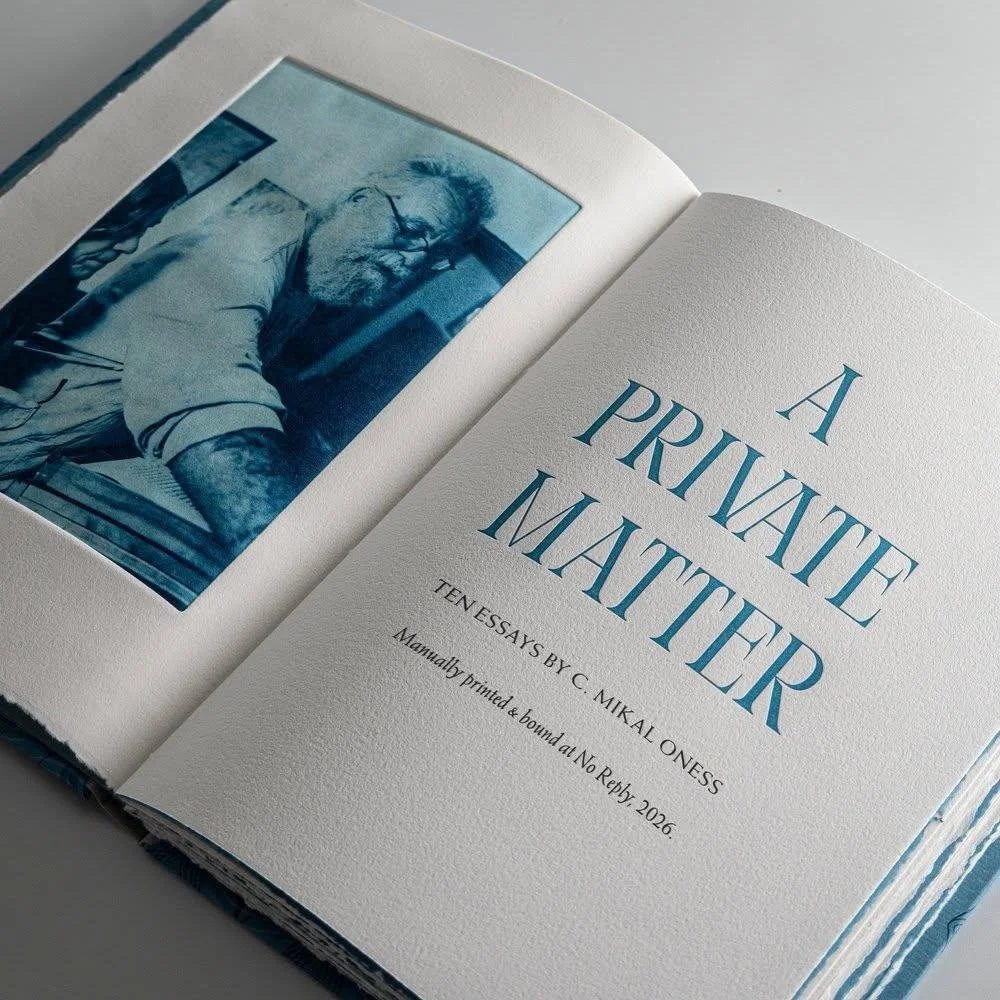
TEN ESSAYS ABOUT BOOKMAKING BY C. MIKAL ONESS⠀•⠀WITH FILM PHOTOGRAPHS
I’m often asked who I consider the finest working printer. Easy: Chad Oness. Since the late 80s, Chad has printed a few dozen editions, all using hand-set types, a manual press, and dampened papers. But the excellence in Chad’s printing can’t be summed up in its craft features. There is something ineffable about it — some wizardry which I am hungry to learn. So, after years of correspondence, I invited myself to Chad’s homestead in Minnesota to see “the master at work”.
The master, it turned out, was more interested in sailing than printing. I met him at a dock on the Mississippi. He drove up in an old Corolla (200,000 miles on the odometer) and put me on a sailboat straight away. Within minutes, I had a rope in each hand and a rudder doing the cha-cha between my thighs. Bald eagles hunted and Chad started talking, but over six hours on the water he said nothing about printing. After docking, we went to his homestead where I expected to find a sublime workshop, a vast laboratory with pristine instruments and a Pantone rainbow of inks. Instead, it was a small pantry room off the kitchen, with a few stray ink cans and flea market tools. I expected his press to be a shining rig, a Rolls Royce of the printed word. Instead, it was worn and rather small, no different than a dozen such proofing presses I’ve encountered at community printing spaces. What I expected to find was a wizard. What I found instead was a gentle giant — the adoptive father of a dozen abandoned sailboats, caring for his green beans, dogs, and squash patch. When we finally got to printing, it became clear that Chad cares passionately about his work. There’s no trick to it, no special tool or approach. The trick is that he cares. When he saw something to improve, he took the time to improve it. What was another hour, another day, another week of work, compared to the lifetimes that this work would last?
I stayed for a weekend, snapping photos on my Canon A-1 camera. I received a masterclass in fine presswork, and in living a fine life. With this edition, I hope to share this masterclass with you.
Chad originally wrote the first essay in this collection in response to my question, “Why make books by hand?” I asked him to keep going because, as you will find, these essays go far beyond the confines of bookmaking, speaking to something more essential. We all have a craft or two. Each of us has interests. Our society calls them “hobbies,” a trick of vocabulary to obfuscate what’s really important. Chad reminds us to build our lives around important things, around that blossom of fire.
The book includes ten essays: A Private Matter, Guillotine for Sale, Cut Away, The Way of the Book, Self Insufficiency, Step Aside Marie Kondo, The Living and The Dead, ‘Around Hand-Bookmaking’, Pictures, and And Then Went Down to the Ship. They cover a variety of topics but all through the window of bookmaking and its related crafts. It has been printed manually on dampened papers — Johannot and Zerkall — which are no longer being made. It represents a few “firsts” for No Reply: It is our first edition to include original photography; It is our first edition to include a patterned paper; It is our first edition to be sewn in a way that makes the book completely layflat. Furthermore, this is the first of what I hope will become on ongoing series of books by bookmakers I admire.
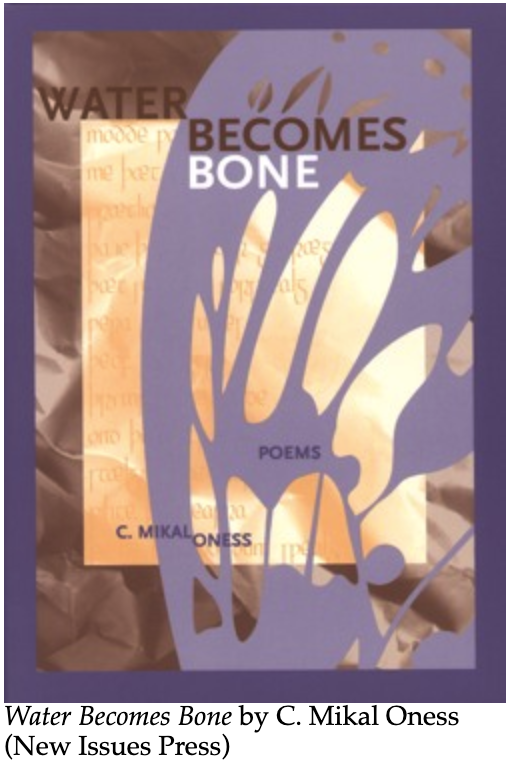
The poems of C. Mikal Oness fade in as if they have been speaking all along in the background in a frequency or volume lost to the human ear until their patience runs out and they enter, reverberating, sleek and insistent. With incantatory lines that are addressed more to the self than to an outward entity, Oness calls to mind Stevens’ idea of the ultimate good—to believe in fictions while knowing they are fictions, to find real bliss only in what is infinitely deferred. There is a tension between what we settle for and what we try to squeeze out of fortune; whether we “keep moving for air” or “chant and kick powder,” the results are all we have, and we do not know enough about certainty to deem them fate or divination. This is a book that searches for that certainty through reversal, and the practice of Water Becomes Bone is to pan for its gospel by yielding to contrast, sifting the bright stones in the mix.
"At times dreamlike, at times sharply rendered, as lapidarian as precious gems, these haunting poems by C. Mikal Oness resound with deft subtleties, fine wit, and striking imagery. In them, Oness confronts our collective desires and fears, our human quandaries, as he delves into the essence of both mundane and cosmic mysteries. Along the way , he explores longing, impermanence, the fragility of our human comforts, the elusiveness of art, and the transmutations that occur between nature and being, death and transcendence. Oness's poems echo the succinct and tantalizing conundrums of Anglo-Saxon riddles, the soul's yearning of Rumi, and the word-playing delight of Gertrude Stein. These poems are small treasures-rich in nuance and song, emotionally complex, resonant and lasting." -- Maurya Simon
"The spare, elegant poems in Water Becomes Bone confront with unusual clarity the joys and the anguish of living with others. The contradictions of this considered life-a son's affections and a son's rage, the bones moving gracefully under a child's skin and the bones of another child resting under the earth-are considered with honesty and with a wrenching beauty. These contradictions are sometimes resolved, sometimes not, but each is confronted with wonder, reverence and awe. Oness is a fisherman, and there are poems in this collection that will have anglers pulling on their waders. This book is like a clear pool you can cast into again and again; every poem is a keeper." -- Gary Young

Overwhelmed by the growing AIDS crisis and the pressures of medical residency, Elena Tristani abandons an outwardly successful life and takes a job writing grants for The Spirit Gate, a holistic clinic that treats recovering drug addicts with acupuncture. Fascinated by the clinic’s founder, who treats Georgetown’s elite and drug detox patients with the same imperturbability, Elena reconsiders her own views on medicine and health. As Elena comes to know the world of the clinic, she is seduced by an ancient Chinese medical text, The Yellow Emperor’s Inner Classic, and begins to see a different relationship between Eastern and Western medicine as well as a new path for herself.
“Twelve Rivers of the Body is an engrossing, provocative portrait of one woman’s odyssey to find meaningful work and her place in the world. Elizabeth Oness’s graceful style is at once precise and luxuriant as she follows Elena from her disillusionment with allopathic medicine into the realm of acupuncture and Taoist philosophy… Twelve Rivers of the Body is an examination of contemporary health problems, a meditation on urban community, and a moving spiritual journey.”
—Valerie Miner, author of After Eden and The Low Road
Winner of the 2007 Gival Press Novel Award "Twelve Rivers of the Body lyrically evokes downtown Washington, DC in the 1980s, before the real estate boom, before gentrification, as the city limped from one crisis to another-crack addiction, AIDS, a crumbling infrastructure. This beautifully evoked novel traces Elena's imperfect struggle, like her adopted city's, to find wholeness and healing."-Kim Roberts, author of The Kimnama
No results match your search. Try removing a few filters.